The Ionian Sea is a valuable natural asset, now at risk
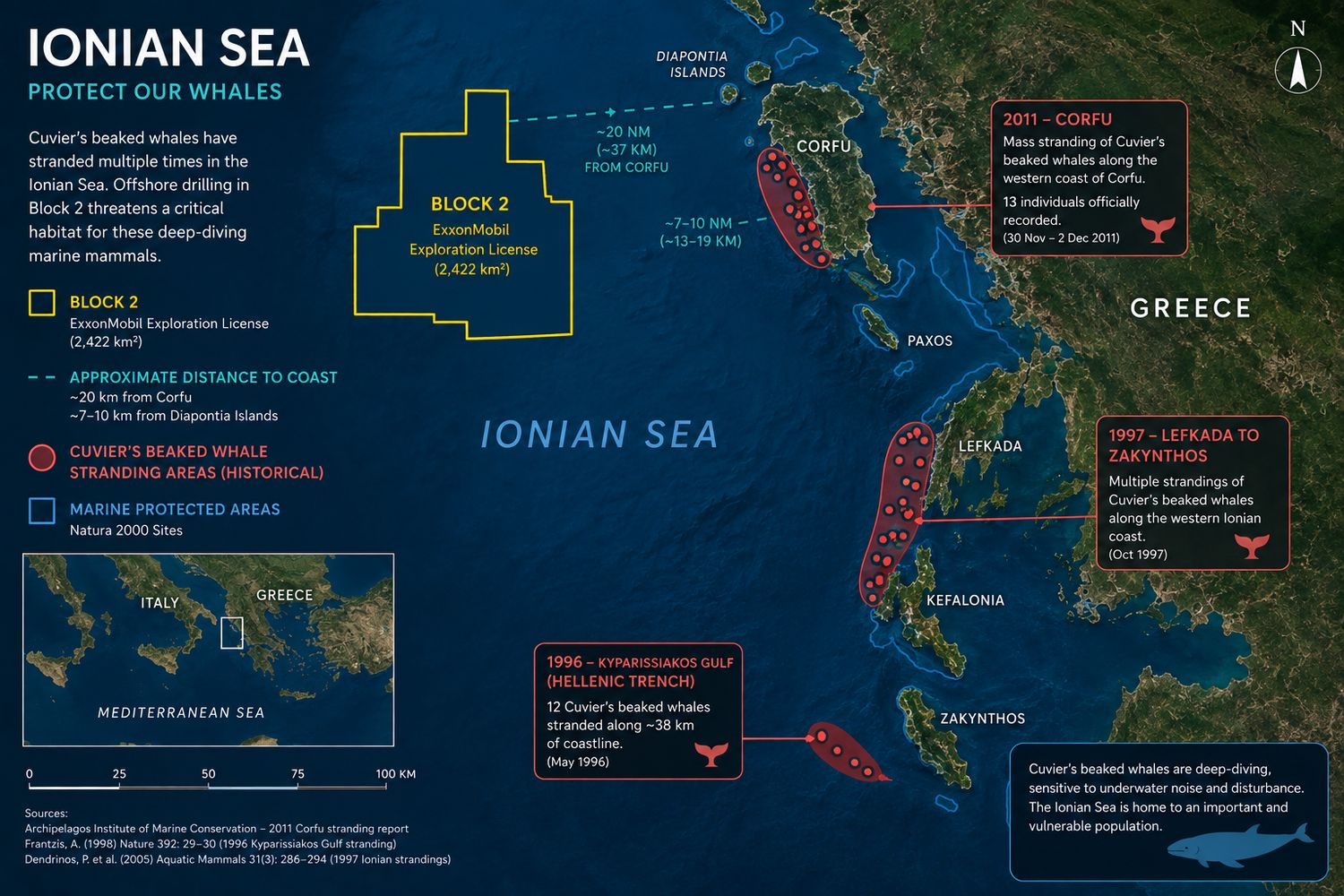
The north-western Ionian is a living deep-sea ecosystem. Its waters support Cuvier’s beaked whales, sperm whales, dolphins, Mediterranean monk seals, loggerhead turtles, sharks and rays, tuna and swordfish, and deep-water coral and sponge communities.
2
The Ionian is a clean sea, beautiful shades of blue, unpolluted from industrial activity even with maritime and commercial traffic. The decision to explore and drill carries environmental and economic risks that extend across the whole living system, a connected ecosystem. Vessel traffic, artificial light, seabed activity, noise, drilling discharges and accidental pollution can affect different parts of the same ecosystem.
Climate and energy choices.
While Greece has set an ambitious target of approximately 82% renewable power by 2030, the weakness lies not in the absence of targets, but in implementation. The failure to build a modern, decentralized and resilient electricity system weakens investor confidence and wastes Greece’s exceptional solar and wind resources. Against that background, opening vast areas of the Ionian and Mediterranean to new oil and gas exploration is not a coherent energy strategy; it diverts political attention and capital toward long-lived fossil-fuel infrastructure precisely when Greece should be accelerating grids, storage, efficiency and locally beneficial renewable energy.
European Commission assessment of Greece’s national energy and climate plan.
Before opening a new deep-water hydrocarbon frontier, the public-interest case should consider not only the possible value of an unproven gas resource, but also long-term emissions, infrastructure lock-in, transition risk and the opportunity cost of putting an already valuable natural asset at risk.
Pollution and accident risk.
Offshore drilling brings drilling discharges, increased vessel activity and the possibility of accidents. The project’s own ESIA acknowledges that a subsea blowout, although assessed by them as extremely unlikely, could be environmentally significant. Even its smaller representative fuel-spill scenario produces possible transboundary effects.
An island economy tied to a healthy sea.
Corfu and the Ionian Islands derive enduring value from clean water, beaches, fisheries, coastal communities, wildlife and tourism. Environmental degradation is therefore not only an ecological risk; it is an economic risk to assets and livelihoods that already exist. Corfu has a vibrant sailing community that stands to lose from high maritime traffic which creates hazards for sailing vessels. Sailors also face increasing risk of accidents and collisions as more ships create navigational hazards.
The Precursor of Decades of Industrial Offshore Development in the Ionian?
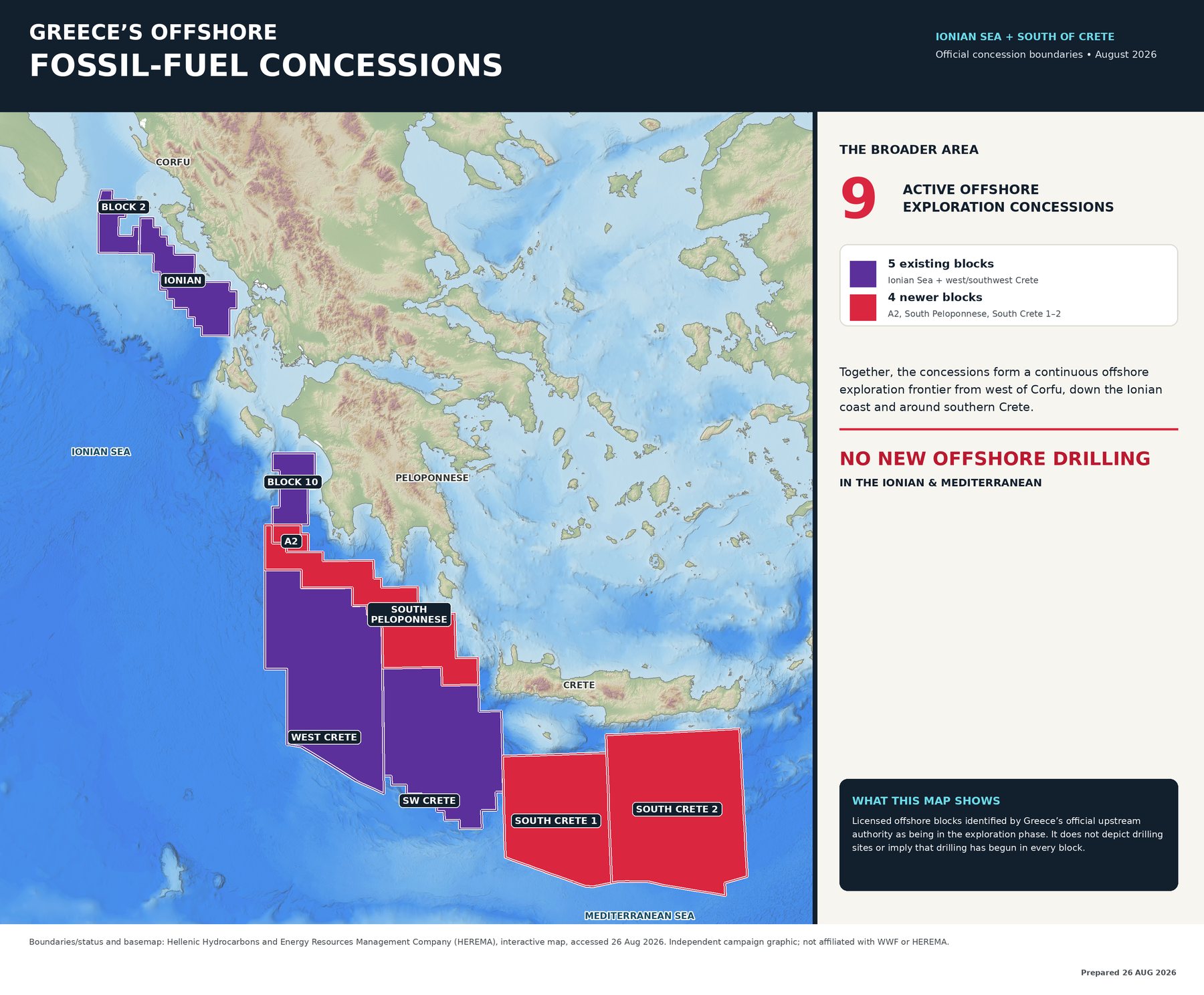
This exploratory well is only the beginning. Asopos-1 is an exploration well. If it makes a commercially viable discovery, further appraisal and potentially a much larger offshore development could follow, bringing additional wells, subsea infrastructure and long-term industrial activity. The current ESIA assesses the exploration operation, not the full footprint of a hypothetical future gas development.
The question is bigger than whether one exploration well can be drilled. It is what future we want for the Ionian.